



Jack Burton
Is there a relationship between art and its potential for real-world impact if our perceptions of art are entirely subjective? On the other hand, are art and impact as disconnected as some modern aestheticians have claimed them to be?
Rather than attempting to definitively answer these complex questions, this project instead explores how these discussions evolved in 18th- and 19th-century Britain, focusing on the broad social practices justified in pursuit of the “picturesque.” Explored through architecture, landscape painting and literature, the popularity of picturesque aesthetics played a significant role in diminishing art’s capacity to be responsible for its tangible effects on the physical world.
During this philosophical preoccupation with the picturesque, broad changes were occurring in the distribution of the landscapes depicted by the art movement. Public and private acts of enclosure continually restricted access to rural Britain in favor of the aristocratic ruling class, permitting them to strip away communal rights from approximately 60% of arable British farmland. A significant portion of the remaining arable land was already held and managed by the same nobility.
To what extent can picturesque landscapes work in a counter direction and revise Britain’s dependence on absolute private land tenure?
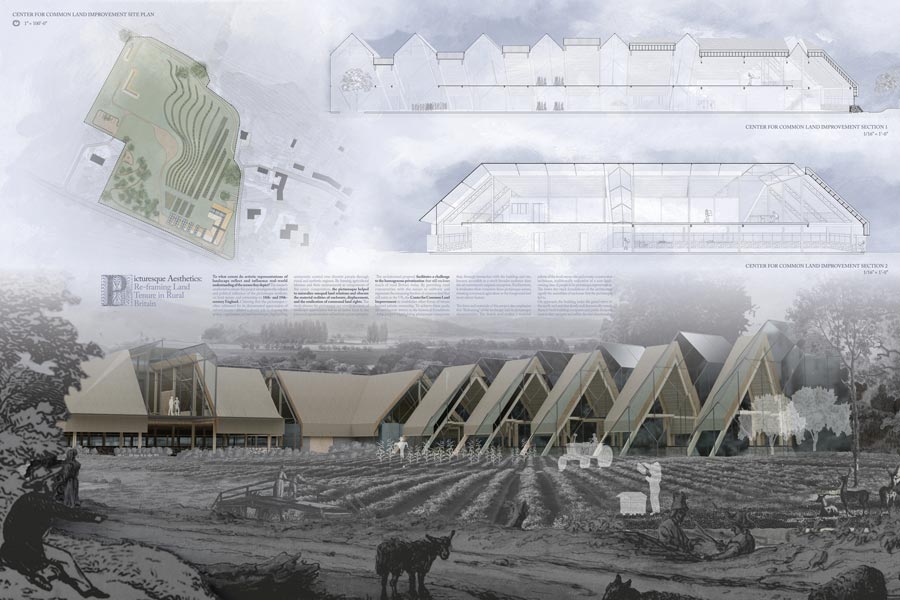
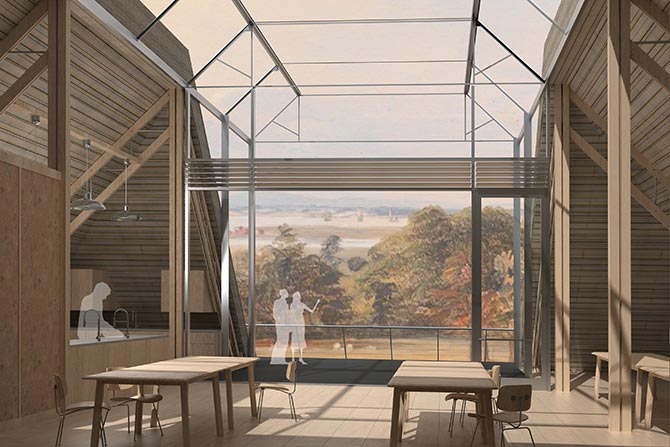
The architectural component of this project attempts to do just that through a return to more communal land distribution, reframing the landscape and making community contribution its most salient feature. The program serves as an incubator that facilitates shared reinvestment in common land, encompassing large, publicly accessible greenhouses and shared facilities for on-site farm operations, alongside amenities that support the preparation and processing of locally grown produce.