


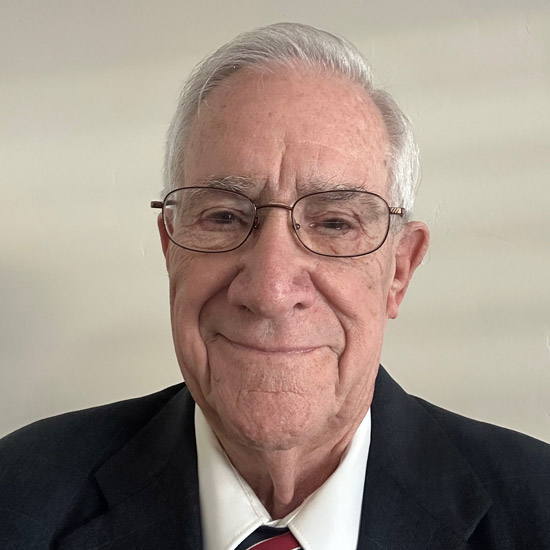


As part of our ongoing series of interviews with architectural legends, we are proud to present this interview with Dr. Ted Smith, FAIA. It was a pleasure to interview him, learn more about his impact on computer-aided architectural design and understand his contributions to the industry. This interview has been edited for length and clarity.
When did you decide to become an architect?
A few years after high school graduation, an engineer friend with the buildings and grounds department at the Salt Lake City School District encouraged me to apply for an open draftsman position. With my drawings from my high school mechanical drawing class, I was interviewed and hired. I soon had responsibility for a variety of small projects for the city schools. After some time, the superintendent of buildings and grounds recommended that I go to college. I started taking a few engineering classes at the University of Utah. A friend who was a draftsman in the same office, Ray Kingston, said, “You don’t want to be an engineer; you want to be an architect.” I looked at the University of Utah architecture program and was initially concerned, because it was a five-year program and I had a family. I decided to try it for one year, got hooked and stayed.
In 1965, our design class was required to participate in the Portland Cement Association Design Competition, and my project won for our school. Professor Don Burgma encouraged me to apply for the regional competition, and I won that as well. As a result, my wife, Bev, and I spent the summer with other regional winners at the Écoles d’Art Américaines in Fontainebleau, France, studying architecture. At the end of the term, I received the only diploma given to the architecture students. I completed my Bachelor of Architecture the same year. I interned and studied for the exam, passed it, and became licensed in 1969.
What was unique about your career?
Following graduation, I went to work at Richardson Associates in Salt Lake. Shortly after, there was a big downturn in business. I was looking elsewhere when a former professor, Robert Wehrli, asked me to join a research project at the University of Utah evaluating the potential of using computer graphics in architecture. At that time, there were no computer-aided design (CAD) programs, and we were drawing everything by hand. I was with the research project for several years and was a co-author of our final report, “ARCAID: The ARChitect’s Computer Graphics Aid.” During that project, I completed a Master of Science in computer science, mainly because I wanted to understand the computer science side of the research. Following completion of the project, I rejoined Richardson Associates in practice.
While working on the research project, Dean Bob Bliss of the Graduate School of Architecture asked me to start teaching. I started teaching the beginning structures classes there, Statics and Strength of Materials. I eventually taught many other classes, started the Computing in Architecture program, was tenured and finally became a professor emeritus of architecture in 1997.
In 1973, while I was teaching, Bob Bliss said that if I wanted to continue teaching in Utah, I needed a degree from another university, since I already had three degrees from the University of Utah. I looked at a few schools that offered doctoral programs in architecture and ultimately chose the one at the University of Michigan. I was admitted in 1973, and our family moved to Ann Arbor that fall. My research and dissertation at Michigan were in computer-aided education in architecture. I received a Doctor of Architecture degree in 1976, then returned to Richardson Associates and the University of Utah Graduate School of Architecture.
Back at the U, I started working with Wayne Rossberg, an architectural graduate and a computer science Ph.D., to install a computer and peripherals and began instructing in computing, computer graphics and 3D modeling. Wayne and I taught all those classes, which eventually became a degree program with a specialization in computing in architecture. We had students from prior architecture programs and from across campus taking our courses.
During that time, I also helped develop an exchange program with KAJIMA Corporation, one of Japan’s five largest construction firms. They would send one of their staff members from their research facilities, along with their family, to our school for one year to acclimate to America and learn English. Our students went there in exchange for a summer every year. I was fortunate to spend a three-month sabbatical leave doing research at their facilities in Tokyo.
Even before I went to Michigan, we were starting to use the computer at Richardson Associates. I wrote the spreadsheet program to handle programming for Taylorsville High School and other projects. We also started using the AIA master specification system (MasterSpec) as a mail-in system. We received a paper copy, marked it up, then sent it back for editing. The AIA would then return the finished copy. We did not think this was a great solution, so we bought time on a time-shared computer, entered the MasterSpec text and began using online editing in our office.
The AIA owned the MasterSpec copyright, but we were a provider and a subscriber and used it in our office. Then other AIA-licensed firms wanted to buy the database, so we started providing magnetic tapes of MasterSpec data to licensed users.
What about ARCOM?
When I returned from Michigan, we started using computers in earnest in our architectural firm. We then formed ARCOM, Architectural Computer Services, within Richardson and bought a computer for the office. In 1987, I bought ARCOM’s assets from Richardson Associates and formed ARCOM as an independent company with two former students, Wayne Rossberg and Angelica Matinkhah.
When we formed ARCOM, we approached word processing companies, including WordPerfect, for help. With their databases, Wayne was able to convert MasterSpec to WordPerfect, Word and several other word-processing programs. What started with three employees soon grew to 13, and we moved away from Richardson, rented some space, and eventually bought a building for offices in Salt Lake. We grew quickly and soon began providing MasterSpec databases on a per-license basis to firms of all sizes across the country.
In the early ‘90s, AIA National asked whether ARCOM would take over all word-processing automation for MasterSpec. In 1995, they asked if we would take on their MasterSpec staff and all other aspects of the system, which we did. We hired 13 people from their staff and operated from an office at the AIA headquarters in Washington, D.C., for a short time before moving to Alexandria, Virginia. ARCOM ended up taking over all aspects of MasterSpec, including creation, licensing, fulfillment and support.
Our staff eventually grew to 45, with all the writing and editing staff in the Virginia office and all the software development, support, fulfillment and sales staff in the Salt Lake office. Over time, we developed versions of MasterSpec for each word-processing system and software to simplify the production of project specifications. We also patented software in 1994 to automate many specification editing tasks, a niche no one was addressing. Around that time, I taught a continuing education class at the U on word processing for architects because the systems were so new and architects wanted to know how to use them.
Clearly, you were visionary. What need did you see in the profession?
We saw a need to provide a better way to edit and produce project specifications. It was so easy to edit and correct with a word processor and other software tools; it made sense to have these tools assist in that part of practice.
Master specifications are written in a three-part format. If you specify something in the first part, it affects the requirements in the second and third parts. We developed software to automate that process and added headers, footers, page numbering, and the like to the project specification. Our firm, ARCOM, had many happy clients because we took a lot of the drudgery out of it with the automation we developed.
Is there anything you would have done any differently?
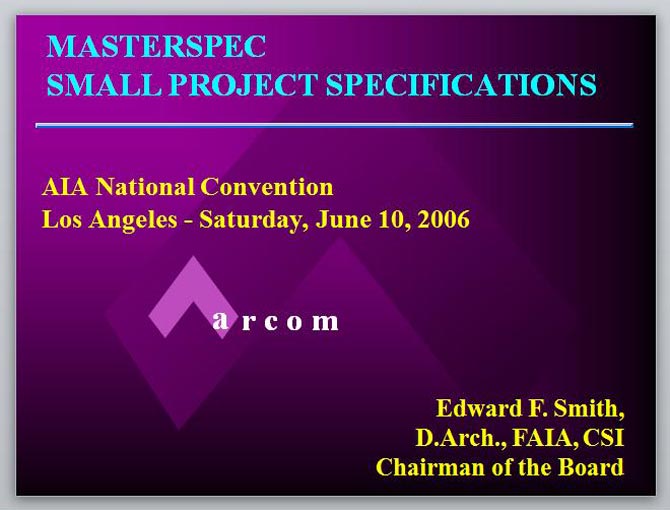
I probably would have started school sooner, and I might have started ARCOM sooner. There are a few things I think we could have done more efficiently, but that’s all in retrospect. I feel very good about what we accomplished for the profession. The AIA really respected us, and we had a wonderful relationship with the AIA National staff. MasterSpec is a great master specification system. People needed it, and we made it easier for them to use it in their practice. In 2006, Bev and I retired and sold ARCOM to three of our employees and Angie, who was already an owner.
Talk about the evolution of architecture from the beginning of your career. You were central to some of those changes.
When I started practicing, we drew everything by hand from concepts to construction drawings. It took a lot of hand drafting to complete a project. When software came along to help with the drawings, it was a wonderful tool, but we needed people who knew how to use it. So, in addition to being a draftsman, architects and staff had to have skills with the available software tools. When AutoCAD and other drawing programs came along, this type of tool made the production process much easier.
My career has been like no one else’s I know in the profession. Many architects go to work at a firm, and they’re there for life, and I have not done that. I became vice president of Richardson Associates. I was there for many years and worked with Bill Richardson the whole time. I treasure that time because it gave me experience on that side of practice, but I was confident I had more to contribute in different areas with my architecture and computer skills.
Advice to younger architects?
Architect education is broad, so architects can fill many roles both within and outside architecture. There are also many specialties. I have a great-granddaughter in architecture school right now working on a dual degree, a master’s in architecture and construction management, and she may specialize in either. I think the computer tools we now have broaden the possibilities for architectural graduates.
I remained active throughout my career in AIA and related professional organizations. I benefited greatly from interaction with colleagues. I served on several committees for the AIA, CSI and the University of Utah. I was fortunate to become an AIA Fellow in 2000 and a CSI Fellow in 2008. I also received the AIA Utah Lifetime Achievement Award in 2012.
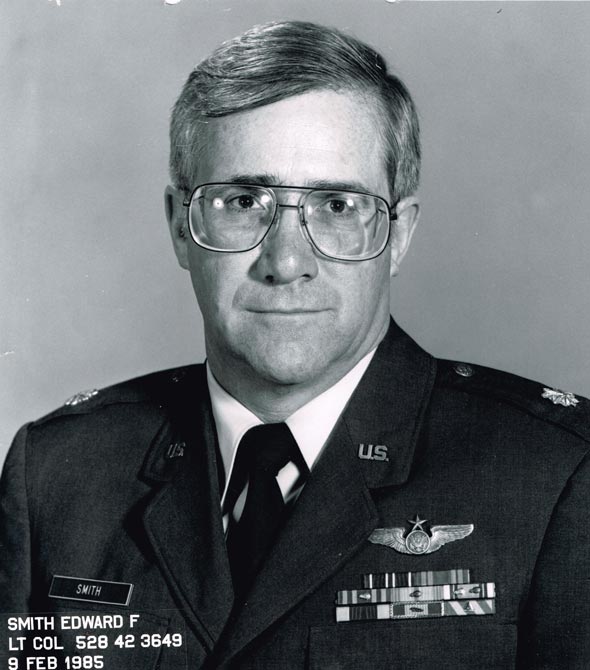
I was involved in many peripheral activities, too. I joined the Utah Air National Guard shortly after high school and spent 16 years enlisted as a flight engineer on heavy cargo aircraft. Later, as a licensed architect, I was commissioned as a captain and served in the Civil Engineer Squadron as the base architect for 18 years. I retired after 34 years as a lieutenant colonel. A very different role for an architect, but one I enjoyed very much.
What’s your impression of computerization and artificial intelligence (AI) today? Has it gone too far?
The AIA and many architects are worried about the impact of AI. What is it going to mean to the architect, the architectural staff and practice? Who will it replace, how much of the practice will be impacted, and who or what software will take some or all the traditional roles of architects?
I really don’t know what the total impact of AI will be. There will continue to be automation, but hopefully it will remain in the parts of practice where you would like help. I think it will be some time before we see the full impact of AI tools as they become available. I remain optimistic that the creative roles of architects will remain. I believe AI has great potential to enhance current building models. I hope AI will be a significant asset to the profession.
Do you have any regrets?
There are few. I regret not having a business education and the skills to run a company like ARCOM. The only thing I didn’t like was having to dismiss employees for various reasons, because nearly all of our employees were so good and so gifted. You don’t find many architects and engineers who want to be the writers who produce these specifications. We were fortunate to have some very good ones. Our chief editor and editorial staff were the best, and every employee in programming, sales, fulfillment and support contributed to our success. I treasure the friendships we had with all our staff, the years of happiness we shared with our ARCOM family, and the many great professional clients who chose to work with ARCOM.