


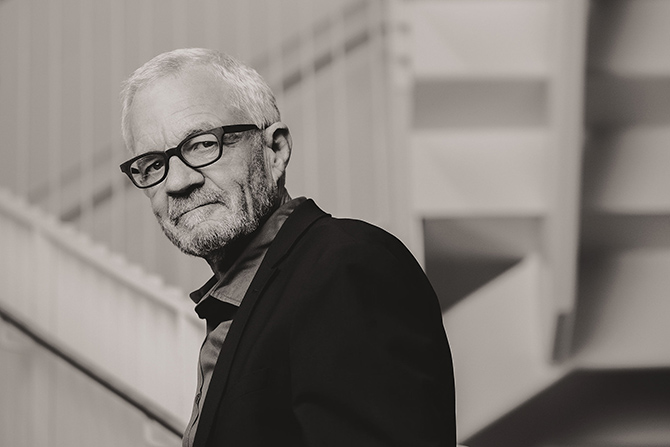

As part of our ongoing series of interviews with architectural legends, we are proud to present this interview with Prescott Muir. It was a pleasure to interview him and to learn more about all the contributions he has made to the industry. This interview has been edited for length and clarity.
Origins
Tell me when you decided to become an architect.
When I was the director of the University of Utah’s architecture school, I always asked the students how they made that decision. It always seemed kind of random. So, I’m going to recommend five books. They inform how and why we make these decisions. Frankly, science would indicate that it’s embedded in us. They infer that it is as much the profession choosing you as you choosing the profession.
The texts are “The Darwinian Survival Guide” by Daniel Brooks; “Sapiens” by Yuval Harari; “Determined” and “Behave,” both by Robert Sopolosky, a behavioral scientist at Stanford; and “Things Hidden Since the Foundation of the World” by René Girard, who was an anthropologist at Stanford. These books posit that human beings are unique among species in that we undergo most of our maturation and brain development outside the womb, and it takes approximately 35 years for our brains to fully form.
That’s a lot of time spent being influenced by others; we are so fundamentally wired to learn by imitation. Girard posits that at some point, the person you imitate becomes the other; the other you invariably envy. You’re learning by copying, but ultimately, they become a rival.
I was impressed by an architect when I was in junior high, Richard Brimley. There’s no doubt that I identified with him. He graduated from the University of Utah. Back then, the Salt Lake economy was struggling. Most of the firms depended on the state or school districts for work, and whenever the state awarded a project, all the draftsmen and recent interns in town would move from one office to another that had secured the most recent job. Brimley ultimately moved to Boston to work for The Architects Collaborative, so fortunately my imitation didn’t end up as envy.
How did you imitate Brimley?
We had a similar period of searching and restlessness while having a lot of expectations as to what the profession should offer.
Education
I started at the University of Utah in 1967, knowing I wanted to be an architect. The U had just transitioned from a five-year undergraduate professional degree to a graduate degree, so I had to choose an undergraduate degree that I didn’t really want to pursue. I started as an art major. Towards the middle of that year, I just decided, “I enjoy art, but I want to be an architect.” So, I went to the dean, Bob Bliss, who was a big advocate for the graduate program because they’d just initiated it. I told him I preferred a five-year track that would be more streamlined than a six-year graduate degree, and he said, “Why don’t you consider Southern Cal?”
I applied, got in and completed my degree, only to find out it would take another three years to get a license. I was working for one of my professors in LA, and my wife was not happy with all the commuting and smog. We went up to San Francisco, where in the early ‘70s, every architect graduate went looking for work.
I remember going into offices. They’d have a big stack of resumes, and yours would go on the bottom, and they would take from the top. I spent a month or six weeks in San Francisco looking for work, then sent a resume back to Salt Lake and got hired by Edwards and Daniels.
Sopolosky might say, “You were just following a path that was laid out for you.” You think you are making choices, but certain doors open and others close. San Francisco was not open; Salt Lake was. I came back here, worked for Edwards and Daniels and then followed Tim Thomas and Steve Petersen when they set up Thomas, Peterson and Hammond Architects. About the time I got licensed, I recognized that the profession wasn’t what I thought it was.
What were you disappointed with?
I think the creative aspect was not what I thought it was going to be. You’re basically cranking out construction drawings and learning how to put buildings together. And at that age, I was anxious to get on with it. I’d gone through school, gotten licensed and realized I wanted more from the profession. I just found that discouraging. So, I thought, “Well, I just need to take some time off and assess my options.” I took a year off and traveled through Europe, looking at all Le Corbusier’s buildings.
I returned and started a studio over Guthrie’s Bike Shop. I thought I could use my undergraduate degree in architecture as a prerequisite to get an MFA degree, only to find out I had to build up all sorts of studio hours first. So, I enrolled at the U in their art program, and it got to the point where I was practicing architecture on the side, paying the bills, and then painting a lot and going to school. I finally got the studio hours to apply to an MFA program and started doing a little teaching as an adjunct at the U. I enjoyed that and decided to pursue a master’s degree in architecture.
I applied to graduate schools in architecture and art simultaneously. I decided, “I’m going to apply to the best schools that I can, and whoever chooses me is the path I will take.” I didn’t get into the art school I wanted, but I got into both Harvard and Columbia’s Master of Architecture programs. One door closed, while the other was open, so that was the path I took. We moved to New York, and I went to Columbia. I was an old student by then, mid-30s. I felt it was hard to keep up with the younger ones.
Sopolosky says your brain is not mature until you’re 35. So maybe age 35 is when you really start understanding who you are or are meant to be. Before that, you’re responding to mentors, to people trying to guide you. I think you start developing a little more confidence. It was a great experience. I learned a lot more about architecture than I did as an undergraduate. Maybe that was maturity, taking it more seriously than an undergraduate would.
I knew I wanted to teach and had some contacts at various schools. I’d get shortlisted repeatedly, go through the process and not get the job. I had a good friend with whom I had collaborated on some projects, Gerald Allen, who also taught at Carnegie Mellon and North Carolina State. He gave me the best advice: “Pursue your career, and if you want to teach, teaching will come to you. If you pursue teaching, you may end up bouncing all over the country at the expense of a career, as architects must be dedicated to a community and building relationships. It’s almost the opposite of academia.”
Private Practice
When I went back to graduate school, I had already started an office in Salt Lake, so I left my office with some very capable guys, but they didn’t really have the necessary management experience and incurred a lot of debt. I said, “We’ll come back to Salt Lake for six months, clean this thing up and then move back to New York.” We moved the family back to Salt Lake, and it took two or three years to clean up the mess and get the business back on track.
By then, the economy had changed; it was tough to find work in New York, and the cost of living was significantly higher. So I ended up staying in Salt Lake, building the practice and then I started teaching. Bob Hermanson invited me to teach a studio with him, so that was the start of 35 years as an adjunct, eventually receiving tenure and teaching studio every other year. Then, eventually, I applied for the directorship and got that. That was such an honor.
Let’s talk about your practice and its trajectory; how did you rebuild it?
It was a lot of cutting expenses, which is painful because the primary expense in an architecture business is labor — people. When you build relationships with people and train them, it’s painful to let them go; that is the brutal necessity of business.
I always felt like I wanted to have an emphasis on design, having seen comparative practices in LA and New York. That was tough in Salt Lake. This was the beginning of quality-based selection, which basically said, “Let’s reward future projects to somebody who has a portfolio of 25 fire stations.” It’s tough to break into that.
So, I thought the prescription for survival was to get some bread-and-butter clients. We started with grocery stores: Smith’s, which became Kroger. After 45 years, they’ve been very loyal to us; they paid the bills that allowed us to pursue more speculative design-oriented work. That was the business model, and I think that worked. I think you tend to get stigmatized by the kind of work you do, which is okay. It’s a business and you’ve got to tend to that aspect, or you won’t survive.
Memorable projects?
The state’s promotion of quality-based selection, almost overnight, forced local architects to team up with national firms that brought the portfolio. That’s still going on. We teamed for the central Salt Lake Library with Gwathmey Siegel. Charles was such a great guy, as was Bob Siegel, his partner. We got shortlisted but weren’t awarded the project. But we developed a very good relationship with those guys.
Subsequently, we pursued the Utah Museum of Fine Arts project on campus, teaming with Charlie and Bob, only to discover that Frank Sanguinetti, the director, did not like the museum that Charlie and Bob had created at the University of Washington. That’s like something I should have known yesterday. So, we didn’t get that, but the project resurfaced in a different form, and we teamed up with Machado-Silvetti, whom I thought was a better fit for Frank Sanguinetti and the campus.
We were able to win that. That was just before the Olympics, and we’d done the programming on it with another firm, so we were very familiar with the project. That was a very rewarding association. We’re still working with those guys. Those partnerships can be difficult, but they can also be very rewarding if you pick the right firm.
We had other collaborations with national firms that were not pleasant. It’s a cautionary tale for younger architects to try to find a good, collaborative, mutually respectful relationship. Otherwise, it can be somewhat painful. You can be subject to abuse when the national firm comes in and you pick them up at the airport, carry their luggage up to a meeting and become their drafting service. They often take the lion’s share of the fees upfront and then leave you with insufficient funds to complete the job.
As a result, we’ve typically tried to go it alone. If it’s not in the cards for a local architect to win the job, then we’re just not going to pursue it. Instead, we focus more on our long-term relationships with clients that become very meaningful over time. You’re on the front line of the stewardship of the buildings that you create, which I think is wonderful.
Architecture as an Evolving Craft
Tell me about the evolution of architecture since you started in the profession.
The tools have changed so much. I don’t think the buildings, per se, have necessarily changed. That’s the interesting thing about architecture. We’re always projecting into the future, but we’ve got this tradition of how to build and that knowledge base. It’s like taking an ocean liner and trying to steer in a different direction.
But the tools have radically changed. When I started, everything was analog. With the Mies School education at Southern Cal, we used Rapidograph pens on Strathmore boards, and those pens never flowed well. You’re trying to keep the thing flowing as you’re drawing, and invariably it splotches, and you would have to start over. I look back on that and wonder why Mies put people through that, especially building models.
We’d do these clear-span exhibition halls like McCormick Place in Chicago, using brass trusses. And Alfred Caldwell would find the little brass shapes that replicated the wide flange beams. They were just meticulous. You’d build these jigs and then set the brass, and you’d cut the brass and set it there and solder it, and then you’d move to the next joint and go to solder that. And the heat from the solder would return to the previous joint and cause it to pop. I’m thinking, why did he put students through that? And I look back on it, and it was all about building discipline. There was this kind of correlation between discipline and stick-to-it-ness and aspiration towards perfection that he was trying to convey through his surrogates (because he’d passed away by then).
I came back to Salt Lake, and everybody was drafting and perfecting their hand lettering. You could go from table to table and identify who had drawn what based on their lettering. There is a real correlation between the hand and the work. There’s a correlation between understanding space and drawing with your hand, and some subliminal connection between the craft of drawing and the craft of building that is lost today. I think there’s no doubt that’s a loss.
In the mid-80s, we were getting into stand-alone computers and a lot of the offices in Salt Lake, like Scott, Louis and Browning, and Edwards and Daniels, were investing in mainframes, very expensive computers, which were a big investment. Young firms, like ours, couldn’t afford a big mainframe, so we opted for desktop computers and worked with a local expert, beta testing a CAD software program for him. Then Autodesk came in and swept away most of the competition.
As I was starting to teach at the U, there was this big debate: “Are we just letting go of analog and everything’s becoming digital?” Later, as director, I really felt that there was a balance, and that analog still had importance and relevance, especially in terms of spatial understanding.
To this day, I can draw faster than anybody can input a design into a computer. You do quick sketches, formulate ideas with the client, and then, when they get more solidified, digitize them and start making changes. Visualization is phenomenal now; it’s hard to differentiate between a rendering and a photograph of a completed project.
Any final thoughts?
I think one of the most rewarding things for young architects, besides the association with clients over time, is mentoring others. There’s always a new group coming on right behind you. We always have that responsibility.
Architecture is hard, and we talked about the maturation of the brain not being complete until age 35. We’re constantly learning. And then you get to a point where you’re forgetting while you’re learning.
I suppose I was meant to be an architect — it just feels good, feels rewarding. I love the team-building, collaboration and sense of galvanizing a community around some concrete objective. It’s always rewarding to feel like you have some sort of legacy, but I’ve seen a lot of my projects demolished. So, be careful what you hang your hat on. It’s more about relationships. Those relationships can be as enduring as the bricks and mortar.